


American Federalism: May in Review
Primary authors: Noah Farnsworth and Johana Linford
In This Edition
Multistate Lawsuits: more states are suing the federal government than ever. What do multistate lawsuits mean for American federalism?

Federalism Flashpoints
Each month we highlight a selection of the most important questions and controversies relating to states, federalism, and the precarious federal-state balance. Our focus will continue to be on monitoring federal and state activities that have implications for the principles of federalism. This month, senior staff editor Noah Farnsworth tackles trends in multistate lawsuits.
Introduction
There is a marked shift happening over the past 50 years in federalism. More often than not, thinking about federalism now requires us to answer the question "who wins where" in court rather than "who controls what" in statutes. This shift is due partly to gridlock and polarization in Congress and state legislatures across the country. As most readers are aware, the Republican party has not passed much major legislation, despite having a unified government in the second Trump term. Most people are cognizant that policy changes have been pushed through more routlinely through Executive Orders, spurring a wave of litigation and endless scrutiny. As such, the "who wins where" question is now increasingly one of state-centered litigation. This phenomena is not new to American politics, but it has made a resurgence over in the past few decades. As some point out, lawfare may simply be an effect of the polarization seen in modern politics. On the other hand, there is an ever present worry that this form of national policymaking might exacerbate polarization, leading to a vicious circle of runawy executive lawmaking and partisan lawfare.
Multistate Lawsuits
Lawsuits brought by Attorney's General have seen a spike since 2024. This spike is important for many reasons. First, the lasting effects of this phenomena may have long-term health effect on our federalist system. These can be both positive and negative.
On the negative side, multistate lawsuits and AG empowered litigation can serve as a surrogate to the actual legislative process. States have always had the ability and willingness to pushback against overreaching federal power. As Jonathan Alder puts it,
"States have long filed suit to push back against federal preemption, resist the commandeering of state officials, and maintain federal funding free of meddlesome conditions."
This pushback from the states has always assumed or served an inherent and visible state interest, one in which the state AGs file lawsuits that reflect the will of the people. But as Alder points out:
"As the number of state suits against the Presidential administrations of the opposite party have proliferated, the identifiable state interests at stake have become diluted. States are suing less to protect their interests as states, and instead they are suing to fly the flag for their preferred team and jump to the forefront of the political opposition."
When this happens and national policy is set by flag-waving and political opposition, "some state suits directly undermine federalism."
On the positive side, a state's pushback against a federal regulation can be seen as a healthy response to a system in need of more checks, precisely those that could be served best by states. Anthony Johnstone has observed that
“[i]f the primary virtue of federalism in these politically polarized times is the accommodation of diverse policy preferences . . . then attorneys general are uniquely qualified to give voice to those preferences in federalism litigation.”
It would be quite tone deaf to expect a state to sit by when national legislation that goes too far, asks too much, or doesn't pass constitutional muster. A state's reaction to this policymaking is expected and needed during our polarized times.
There is a rich and growing scholarship on the pros and cons of multistate lawsuits. Our purpose here is not take a particular side. In the next section, we will examine major trends over time, patterns at the state level, win and loss ratios, and how the federal government is also using litigation to further their interests. We will also highlight some specific multistate lawsuits from the past few months showing how these lawsuits are affecting national policy.
Special thanks to Dr. Paul Nolette for his amazing website attorneysgeneral.org and team who have complied much of this data. Also thanks for Johana Linford at the Federalism Index Project for filling in some gaps and for the charts and graphs.
II. Empirical Trends
I. Growth of State Litigation
This chart shows the number of multistate lawsuits per presidential administration since 1980.

As above, multistate lawsuits have increased steadily over the past few decades, with a peak during President Trump's first term (160 lawsuits). According to one current tracker, there have been 24 major multistate lawsuits filed against the second Trump administration. By our count, without filtering, there there have been 57 multistate lawsuits against the federal government so far in Trump's second term.
II. Partisan Patterns
Do states controlled by the party opposite to the White House file more lawsuits? Perhaps not surprisingly, the answer is yes.
Below are two separate tables that illustrate the quantity of Democratic-led and Republican-led lawsuits against the federal government. As expected, during opposite party control in the White House, the states brought forward numerous lawsuits. From the charts, we see that Democrats usually bring more lawsuits when a Republican President is in office.
Also of interest, Democrats appear to be slightly more likely to bring lawsuits against their own party than Republicans, as shown by the 13 lawsuits during the Obama administration and 8 during the Biden administration:


research note: the charts above looked at lawsuits led exclusively by Republican or Democrats and did not measure lawsuits in which both parties were parties (plaintiffs) in a lawsuit. The figure below highlights cases joined by both Democratic and Republican AGs.
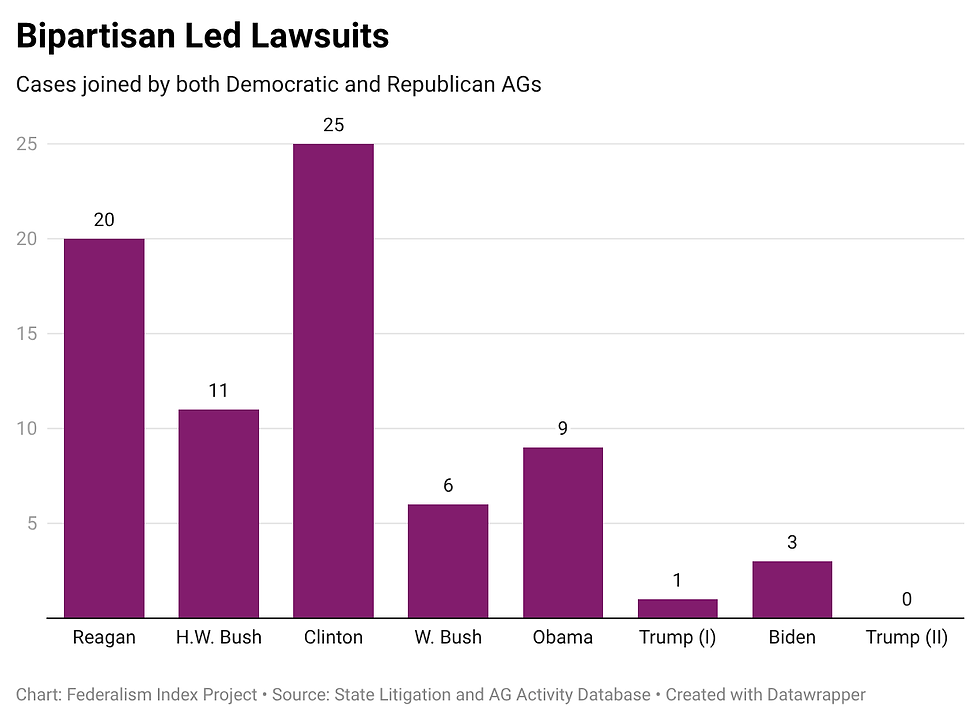
This figure seems to confirm the suspicion of scholars writing on multistate lawsuits in the modern era. In a Texas Law Review article, written by Margaret Lemos and Ernest Young, the authors explore the relationship between state litigation and the polarization of American politics. Lemos and Young come to a few conclusions. First, they argue that as the office of Attorney General becomes more polarized, the litigation pursued will likely become political as well.
"Similarly, the trend toward unified government in the states is likely to produce more polarization, and less bipartisanship, in state litigation. Until relatively recently, it was not uncommon to find Democratic AGs in otherwise red states. And, because most states had divided government, most AGs had to contend with an opposite-party legislature or governor. It stands to reason—and there is some evidence to support this notion, discussed below—that AGs who hail from a different party than other state leaders will tend to take a more moderate approach to litigation than those who work in states with more one-sided politics. But those “purple” seats are becoming less common, as more states turn to unified government and more AG races follow suit."
Lemos and Young also point to research done by Paul Nolette, which analyzed the different lawsuits state AGs were joining. Nolette distinguishes between policy-forcing and policy blocking lawsuits:
"Whereas state suits against corporations have been largely bipartisan affairs, Nolette found 'wide partisan splits among AGs' in what he calls 'policy-forcing' suits—cases in which states have 'attempted to force [federal agencies] to take a more active regulatory approach.' He found partisanship to be playing a dominant role in 'policy-blocking' litigation as well—a category of litigation that he defines as 'state legal challenges to regulatory actions by federal policymakers' though the roles were reversed. Whereas Democratic AGs had taken the lead in 'policy-forcing' litigation since the George W. Bush Administration, Republican AGs were at the forefront of “policy-blocking” litigation under President Obama.
III. Outcomes and Success Rates
Thinking about partisan winning partisan versus losing may not be the most helpful form of analysis, especially if we think of federalism in its most (relatively more) cooperative eras. However, because litigation focuses on outcomes for competing parties, a focus on winning or losing can help us understand current trends. Below, we present the outcomes of present-term multistate litigation cases, divided into four categories: Final Wins, Temporary Wins, Loss(es), and Awaiting Decision.
We define these categories as follows:
Final Wins: A final win is when states fully prevailed in court and the ruling is final, with no further appeals pending or possible.
Temporary Wins: A win is when the states succeeded at a major stage of litigation, such as securing a temporary restraining order. These wins often pause or narrow federal rules and gives states significant leverage. These also include cases where the plaintiff state won in part of the lawsuit, but lost in another.
Awaiting Decision: Refers to cases which briefing or argument has occurred, but the court has not yet issued a decision.
Loss: A loss means the states' challenge was rejected by the court, either at the trial or appellate level. The federal rule or action remains in place, unless appealed to a higher court.
We can briefly compare the wins and losses from previous administrations, as follows:
The overall win rate of Republican AGs vs. Biden: 74.1%
The overall win rate of Democratic AGs vs. Trump I: 83.0%
The overall win rate of Republican AGs vs. Obama: 64.2%
If we exclude "Awaiting Decision" from our count, the current running "win" rate for Democrats against Trump is roughly 78%, so far, close to the record high rate of wins secured by Democrats against President Trump in the first term (83%).
IV. Maps
To further illustrate the partisan nature of multistate lawsuits, we have included a map which shows the number of multistate lawsuits joined by each individual state in either the Biden Administration of the second Trump Administration (Trump II).
During Trump's second term, California leads the way in joining the largest portions of lawsuits amongst the states. Louisiana (R) or Montana (R) joined the most lawsuits during the Biden years.
This trend echos the claims stated earlier by Jonathan Alder. As more states join lawsuits in increasing numbers, it is increasingly possible that the supposed state interest can become diluted because of the way in which states might be incentivized to join lawsuits for partisan reasons.
IV. States Using Litigation
States pursue multistate lawsuits for a variety of reasons. In 2026 alone, there have been 30 multistate lawsuits against the federal government. These include lawsuits on immigration, environmental standards, tariffs, government grants/loans, criminal statues, and more. A full list of these lawsuits can be found here.
For this newsletter, we will look briefly at one major lawsuit filed this month, joined by 25 states.
Federal Student Loans
In mid-2025, Congress passed the "One Big Beautiful Bill Act" (H.R.1), which among other things, provided a sweeping overhaul of federal student lending. This bill split post-baccalaureate borrowers into two categories – "graduate students" and "professional students" – and set different borrowing caps for each group. Starting in July 1, 2026, graduate students will be permitted to borrow up to $20,500 annually and professional students up to $50,000 annually.
To draw that line, Congress incorporated an existing federal regulation’s definition of “professional degree”, which covered programs that (1) qualify graduates to begin practicing a profession, (2) require skills beyond a bachelor’s degree, and (3) generally lead to licensure. The regulation also listed examples (medicine, law, dentistry, pharmacy, etc.) but made clear the list was illustrative, not exclusive.
In May 2026, however, the Department of Education issued a new rule redefining "professional degree" more narrowly. The complaint against the rule noted: "The Final Rule narrows the definition incorporated into H.R. 1 and effectively makes the illustrative list of degrees exclusive, thereby excluding many healthcare and other professional degrees that would otherwise be eligible for the higher limits."
On May 19, the state of Maryland, joined by 25 states, and the governors of Kentucky and Pennsylvania, filed a lawsuit against the Department of Education and Secretary McMahon. They argue that Congress, through H.B. 1, locked in the existing federal definition of professional degree to determine loan qualifications and that the Department of Education, through their new May 1 Rule, unlawfully rewrote that definition. They argue that the Department's move to make the illustrative list of degrees exclusive and by adding new criteria not found in the text Congress adopted violated statutory authority under the APA. Additionally, they argue that the Rule is arbitrary and capricious. They point out that the Department relied on factors Congress never intended, applied them inconsistently, and ignored alternatives raised during negotiated rulemaking.
The states boil their standing theory down to two points: the Rule costs state institutions money and disrupts state workforce pipelines. Public universities will lose tuition revenue when students can’t borrow enough to enroll in high‑cost professional programs, and states say the narrower definition will worsen shortages in fields they are responsible for staffing, especially healthcare. Those concrete financial and operational harms, they argue, give them a clear basis to sue.
V. Federal Government Using litigation
Finally, while states are continuing to use their litigation power and are usually winning against a very active Executive branch, the federal government in the past few months has also used their litigation powers to enact policy. States are not the only ones resorting to litigation in the absence of compromise, cooperation, and coordination. According to one source, there have been at least 22 lawsuits brought by the Trump administration challenging state or local laws and policies, from suits against sanctuary jurisdictions to suits challenging state immigration-related restrictions, and more recently, suits over ICE undercover license plate policies.
"Agonistic Federalism"
What does this mean for the future of the federal state balance?
Scholarship from Aziz Huq and Zachary Clopton shows that litigation is important, but also simply part of a broader phenomena in state and federal relationships. Labeled "Agonistic Federalism", Huq and Clopton argue that this wave of federalism is marked by a
"zero-sum, no-holds-barred style of contestation between the national government and states characterized by mutual, partisan antagonism and intolerance."
According to Huq and Clopton, the federal government's dysfunctional relationship with the states is manifest primarily in three ways.
"The weaponization of states’ entanglement in cooperative federalism programs, and their consequent reliance upon—or at least cooperation with—certain forms of federal support.
The withdrawal of federal provision of public goods upon which the states have reasonably relied in ways that immediately impose material costs upon states’ residents.
The transformation of policy disputes into matters of criminal law enforcement, or the use of individually targeted punitive measures for policy ends."
An example of what these authors would call a "dysfunctional relationship" can be seen in the DOJ's request recently for voter information, which has prompted resistance from both Democrat and Republican state legislatures.
Requests for Statewide Voter Lists
Starting in March 2025, the Department of Justice initiated a campaign, either through formal request or litigation, to obtain the full, unredacted statewide voter lists. Historically, the federal government has not required this information to be shared. The request was met with instant pushback from the states who cited state privacy laws and federal laws such as the National Voter Registration Act (NCRA) and the Help American Vote Act (HAVA). By April 2026, the DOJ had sued over 30 states and Washington, D.C. for noncompliance.
As of May 1, 2026, federal courts have dismissed DOJ lawsuits against:
Those states who have not had their cases dismissed by federal courts have chosen to go one of three routes.
Some states have responded to the DOJ's questions on voter registration compliance. These states tend to request information from the DOJ on how the voter information will be used and how they will work in compliance with national and state privacy laws. These states have not given up any information though. States include: Georgia, New Hampshire, Washington.
Other states have responded to the DOJ's questions and instead has pointed them to their publicly available version of the lists, which exclude private information such as dates of birth of partial SSNs. So far these states include: Colorado, Pennsylvania, Utah, West Virginia.
Other states have responded to the DOJ's questions and provided them access to their full voter registration lists. These states include: Alaska, Arkansas, Indiana, Kansas, Louisiana, Mississippi, Nebraska, Ohio, South Dakota, Tennessee, Texas, Wyoming.

In the cases where federal judges have ruled against the administration, they have held that the federal statutes relied on by the DOJ – such as the NCRA, HAVA, and Title III of the Civil Rights Act – do not give the Attorney General the authority to compel states to hand over unredacted voter data. In the rulings, courts emphasized that maintaining compliant state voter rolls in a state responsibly and the DOJ's request is an unconstitutional overreach into state powers. For example, in Rhode Island, Judge Mary McElroy called DOJ’s request a “fishing expedition” not authorized by federal election statutes.
Summary
Compliance with the DOJ’s request reveals an interesting dynamic. Given that most states challenging the order have prevailed in court, one might expect that any state viewing the request as federal overreach would immediately turn to the judiciary for relief. However, compliance has generally broken along partisan lines. Republican‑led states tend to have more permissive voter‑file disclosure laws, ideological alignment with federal roll‑maintenance efforts, and existing data‑sharing practices. Democratic‑led states, by contrast, face stronger privacy constraints and view the requests as federal overreach.
For more information:
VI. Conclusion
Multistate litigation is no longer a peripheral feature of American federalism.
It has become one of the primary ways states and the federal government contest for power, craft policy, and in some limited ways at least, try to further define constitutional boundaries. Whether viewed as an essential safeguard against federal overreach or as a symptom of growing political polarization, the trend is worth watching going forward: courts, not Congress, are increasingly serving as the main "zero sum" arena where federal-state conflicts are resolved. The challenge is determining whether this litigation-centered model strengthens the federal system by preserving meaningful checks and balances, or weakens it by replacing negotiation and compromise with perpetual legal warfare.


Comments