


American Federalism: February in Review
Updated: Apr 8
In This Edition
How are states responding to ICE enforcement?
What is changing in U.S. Elections?
Why are so many states redrawing their maps?

Federalism Flashpoints
Thank you to everyone who has been following as we make updates. Each month we highlight a selection of the most important questions and controversies relating to states, federalism, and the precarious federal-state balance. Our focus will continue to be on monitoring federal laws that have implications for the principles of federalism.
February in Review
February was eventful in a number of ways. Many unique events required an all hand approach from cities and states, as they sought to balance their authority with an engaged and active federal government.
We start with how states have been responding to ICE operations within their jurisdiction. We will highlight the different approaches taken by states and how this squares with the principles of federalism. Next, we move to the SAVE Act; a new piece of legislation that could have a tremendous impact on how states administer federal elections. We end with a survey of the redistricting efforts happening all across the country and examine the impetus for the changes and the roadblocks each of these states are experiencing.
We hope you enjoy this month's issue of American Federalism!
Introduction
Since the start of the new year, the federal government has drastically expanded their immigration enforcement and operations in several states. The most visible of these has been Operation Metro Surge in Minnesota, cited by the DHS as the "largest ICE operation in history."

The surge in Minnesota was met with instant and dramatic pushback, not only from the people living in Minnesota, but also state and local government leaders. There have been at least 5 major lawsuits filed in Minnesota related to federalism concerns, including state sovereignty under the Tenth Amendment, which has led to the eventual pullback of officers, but not before two U.S. citizens were shot and killed by ICE agents.
Operations in Maine took a different turn. As with the operation in Minnesota, the initial deployment of troops and officers led to instant public pushback, with protests and public demonstrations. However, the immigration operation didn't last very long and officers were quickly pulled away from the state. Maine’s legal actions so far are fewer and more narrowly focused on civil-rights responses to ICE conduct and compliance with court orders in detention cases.
Below, we will explore a more detail account of the operations in Minnesota and Maine to highlight how states and the government are both appealing to the principles of federalism to accomplish their goals.

Case Study — Minnesota: Operation Metro Surge
What happened: Starting in late December, ICE announced an enforcement surge in the Twin Cities. Minnesota — particularly Minneapolis and St. Paul — had longstanding limits on local cooperation with federal immigration detainers. Federal officials argued that local policies reduced information sharing and limited ICE’s ability to transfer custody from local jails. The surge was described by DHS officials as an effort to “restore operational control” in jurisdictions viewed as non-cooperative. Federal officials also made repeated references to the Somali population living the the state, many of whom are living here on work visas or illegally. The operations were presented primarily targeting illegal immigrants who had previously been convicted on criminal charges, although some analysts have described it as a test case for a more visible, assertive enforcement model designed to deter sanctuary-style resistance.
According to DHS, through the next two months, ICE carried out over 4,000 arrests. After the shooting of Renée Good and Alex Pretti, statewide demonstrations in Minnesota against ICE operations expanded significantly, including marches, rallies, and a coordinated “economic blackout” protest, with organizers estimating tens of thousands of participants across the Twin Cities and beyond in subzero temperatures. Hundreds of businesses closed or altered operations in solidarity. After intense scrutiny by state officials and U.S. Congress members, Border Czar Tom Homan announced the end of Operation Metro Surge, with ICE agents gradually leaving the state through all of February. Separate court filings describe Minnesota post-"drawdown" activity as roughly 20 arrests per day.
State response: Since the beginning of the operation, state and city officials have been explicit about not cooperating with ICE agents. Minneapolis Mayor Jacob Frey said that "we do not cooperate with ICE or any agency around enforcement of federal immigration law, period." Governor Tim Walz was equally outspoken in his criticism of the operation saying "The federal occupation of Minnesota long ago stopped being a matter of immigration enforcement. It is a campaign of organized brutality against the people of our state." In response, DHS publicly claimed that Walz/Frey “refused to cooperate” and alleged nearly 470 “criminal illegal aliens” were released from jails “back onto the streets.”DHS/administration allies have also claimed 1,360 ICE detainers had been ignored, endangering public safety.
Legal battles: At the end of January, a federal judge rejected an injunction bid from the state. In her opinion, Judge Menendez noted that she was sympathetic to the state's claims, such as racial profiling from ICE agents, excessive use of force, and the harms the operation has done to the daily lives of Minnesotans. However, she said she was reluctant to stop the operation from happening. "There is no clear way for the Court to determine at what point Defendants’ alleged unlawful actions... becomes so problematic that they amount to unconstitutional coercion and an infringement on Minnesota’s state sovereignty." Other legal battles have ensued over techniques in police force and access to attorney's for those individuals who are detained.
Federalism Principles: Minneapolis & St. Paul v. DHS/ICE/CBP is an ongoing case that challenges Operation Metro Surge on constitutional grounds (Tenth Amendment). Tincher v. Noem alleges First and Fourth Amendment violations by ICE and federal agents.
Federal shift: After weeks of sustained enforcement and mounting political pressure Border Czar Tom Homan announced that ICE operations in the city would be slowly pulled back. Speaking on the change, he said that there has been increased cooperation between federal, state, and local officials. Additionally, he mentioned that agents would remain in the city, but operations would primarily happen behind closed doors, such as in detention centers and jail rather than on the streets.
Case Study — Maine: Operation Catch of the Day
What happened: Operation "Catch of the Day" was launched on Jan. 20th, as a large scale enforcement surge in Maine. Of the operation, Assistant Secretary Tricia McLaughlin said "Governor Mills and her fellow sanctuary politicians in Maine have made it abundantly clear that they would rather stand with criminal illegal aliens than protect law-abiding American citizens." Reports indicated that over 100 arrests were made within the first few days.
State response: The operation drew immediate pushback, with state officials calling for more transparency in agent behavior and operations and standing in solidarity with the immigrant communities. Governor Janet Mills called for ICE agents to show warrants before arrests and two Congress members from Maine wrote a letter to DHS Director Kristi Noem requesting details about the scope of the operation and signaling their concerns.
Public reaction: Early on in the operation, many advocacy groups were very critical of the tactics and the claims from DHS. Independent reporting concluded that a large portion of those detained by ICE had no criminal record and others were in the legal process of receiving citizenship. Neighborhoods in cities like Portland and Lewiston set up watch programs to alert neighbors of ICE agents in the area and school districts switched over to online learning for their minority students.
Legal battles: in Maine, there have been fewer examples of lawsuits challenging the federal government on grounds of state sovereignty. A number of smaller class-action lawsuits have been filed in the state, focusing on first amendment rights to observe, surveillance, and ICE conduct in immigration, custody and procedural compliance. A new lawsuit filed in the U.S. District Court of Maine, accuses DHS of violating First Amendment rights by using surveillance technology to spy on and collect data from citizens in the state. "The complaint details multiple incidents in which the plaintiffs said federal immigration officers scanned observers’ faces and license plates, and threatened to appear at their homes and place them on a domestic terrorist database."
Federal shift: On January 29, 2026, U.S. Senator Susan Collins (R–ME) publicly stated that the Department of Homeland Security had ended the “enhanced” ICE operation in Maine, meaning the temporary surge of federal immigration enforcement agents had been wrapped up and no large-scale ICE raids were ongoing or planned in the state at that time. Some argue that the pullback illustrates how federal enforcement ultimately depends on local cooperation. While Maine cannot legally block federal immigration enforcement, state officials exercised lawful state powers to resist, delay, and scrutinize federal actions they opposed.
Other Examples and Trends
The reaction from states isn't always a negative one.
In fact, there are many states that have been fully engaged and cooperated as much as possible with federal immigration enforcement. Often done through what are called 287(g) agreements, governors have the power to deputize local officers to perform certain federal immigration functions.
Florida is being cited as a positive example, by some. Under Gov. DeSantis, the state deputized all 67 county sheriffs and multiple state agencies to assist DHS in their operations. States such as Texas, Arizona, and parts of North Carolina use detention contracts, data-sharing agreements, and local policies that reflect federal immigration goals. These states have codified laws into their constitution that requires the assistance of local law enforcement for all future immigration operations.
The SAVE Act
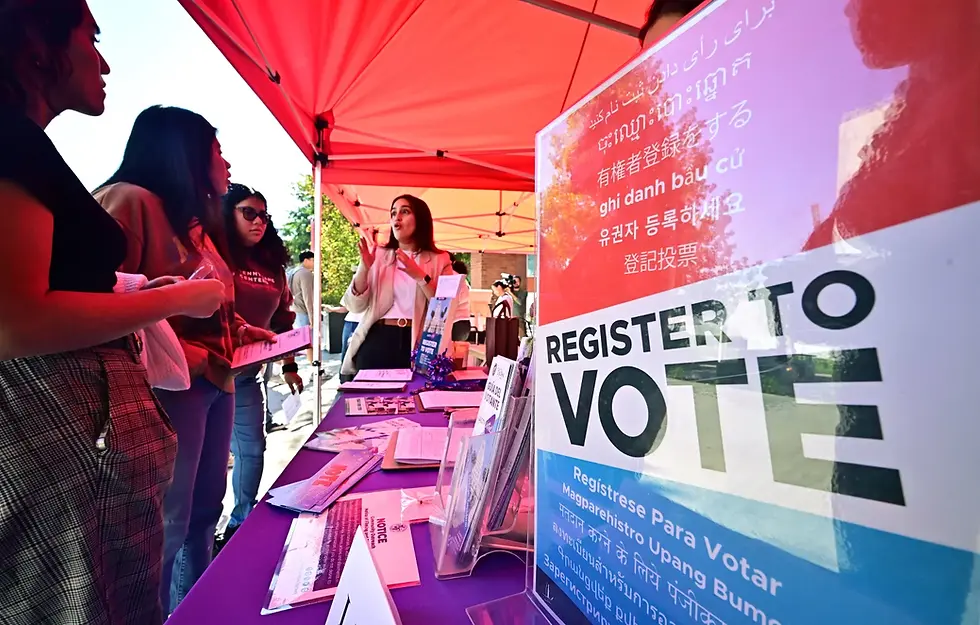
The Safeguard American Voter Eligibility Act, better known as the SAVE Act, has quickly become one of the most hotly contested bills in Congress this year. Senate Minority Leader Chuck Schumer has described the SAVE America Act — which includes the SAVE Act’s proof-of-citizenship rule — as tantamount to “Jim Crow” laws that would suppress voting rights. Republican lawmakers have countered that Democratic warnings about voter suppression are “nonsense” or overstated, maintaining that the SAVE America Act simply reinforces existing laws and that proof-of-citizenship requirements are “flexible.”
Federalism Principles
The Safeguard American Voter Eligibility (SAVE) Act has become a flashpoint in the federalism debate because, by imposing a federal proof-of-citizenship requirement on state voter registration systems, it challenges the traditional constitutional balance that grants states primary authority to administer federal elections. Some worry that the sweeping changes in elections and voting signal a power shift between Washington and the states.
What the Bill Actually Does
Here is the language from the bill summary on Congress.gov
"This bill requires individuals to provide documentary proof of U.S. citizenship when registering to vote in federal elections.
Specifically, the bill prohibits states from accepting and processing an application to register to vote in a federal election unless the applicant presents documentary proof of U.S. citizenship. The bill specifies what documents are considered acceptable proof of U.S. citizenship, such as identification that complies with the REAL ID Act of 2005 that indicates U.S. citizenship.
Further, the bill (1) prohibits states from registering an individual to vote in a federal election unless, at the time the individual applies to register to vote, the individual provides documentary proof of U.S. citizenship; and (2) requires states to establish an alternative process under which an applicant may submit other evidence to demonstrate U.S. citizenship."
Federal law is explicit that only U.S. citizens are permitted to vote in federal and state elections. However, states are often the ones who decide how this is administered and enforced. All states currently require all new voters to attest their citizenship at the time of voting and each state maintains a voter registration list.
The Pushback
The pushback against this bill seem to be coming from two directions: first, there is an argument that implementation of the bill would disenfranchise large amounts of voters and second, the bill is viewed by some as an unconstitutional use of federal power.
Disenfranchisement
Opposition to the bill within Congress, especially amongst the Democrat members, focuses on the harm this bill would do to already eligible voters. A study done by the University of Maryland found that as many as 21 million eligible voters do not have easy access to documents that provide proof of citizenship. Senate Democrats have promised that the bill is "dead on arrival in the Senate" and that they will filibuster the vote on the floor.
Unconstitutional
Much of the pushback from the states is due to the preemptive nature of the bill. A core federalism criticism is that the SAVE Act would preempt longstanding state control over election administration and voter qualifications — a domain traditionally reserved to the states under the Constitution’s Elections Clause and 10th Amendment.
States have the power, vested by the Constitution, to regulate elections. In a press release by the National Conference of State Legislatures, they state that "the federal government may (and every so often does) pass laws intended to govern how federal elections are run" but that "because states usually conduct federal and state elections concurrently, any federal law regarding elections will likely affect the nuts and bolts of how states run all elections and the balance of the federalist system. "
Other commentary, perhaps more controversially, focuses on the citizenship requirement assumed by the bill.
The U.S. Constitution is notoriously silent on voting requirements, especially when it comes to citizenship. There have been amendments that prohibit certain groups from being disenfranchised, but these only extend to race, gender, and age. But as one law professor put it:
"The SAVE America Act presents a constitutional dilemma. By requiring individuals to show documentary proof of U.S. citizenship to vote, the SAVE America Act is implicitly saying that someone must be a U.S. citizen to vote in federal elections. In other words, Congress would be instituting a qualification to vote, a power that the Constitution leaves exclusively to the states."
Proponents of the bill have pointed to other sections of the Constitution to counter the claims made above.
For one, they point to the Elections Clause, which provides Congress the power to regulate the "Times, Places and Manner" of congressional elections.
This understanding of the elections clause is seemingly backed up by a 2013 Supreme Court case, Arizona v. Inter Tribal Council of Ariz., Inc. This case held that the NVRA blocks states from requiring documentary proof of citizenship on the federal voter‑registration form. The Court said Congress controls those federal registration rules, so states must accept the Federal Form as written. Members of Congress is support of the bill seem to be using the same logic to rewrite the NVRA to require documentary proof nationwide.
The Federalism Stakes
The debate ultimately turns on two competing views of election administration.
Supporters of the bill argue that federal elections require uniform rules and protect the integrity of elections nationwide. Opponents argue that the bill would nationalize vote eligibility, and change over 200 years of state control over voting.
States now stand in the crossroad of a bill that could significantly alter not only their numbers of voters in upcoming elections, but change the way in which election administration happens for decades.
Midterm elections are important during any election cycle. Since World War II, the president’s party has lost an average of about 26 seats in the House and 4 seats in the Senate in midterm elections.
This year, Republicans are looking to bolster their slim majority in Congress and Democrats are trying to flip Congress like they did in President Trump's first term.
In April 2025, strategist James Blair presented a plan involving coordinated state-level redistricting. The administration called on Texas Republican leadership to redraw congressional districts to create more GOP-leaning seats. Texas became the testing ground.
As of writing, 6 states have new maps already enacted or in effect. 3 states are planning or moving toward redistricting. 7 states have seriously considering it, but efforts have stalled. It has been called one of the largest mid-decade redistricting efforts in modern U.S. history.
While some of this due directly to political pressure has come from the White House, others are clearly a reaction from Democrat majority states to balance Republican pre-election maneuvering.
Some states have undergone redistricting through referendum, others through state legislatures, and others have been required by their own Constitutions to do so. Regardless of the method, this amount of redistricting is unique and will shape voting maps beyond just this election. What began as a state-level strategy in Texas quickly evolved into a multi-state institutional competition, with roughly one-third of the country considering mid-decade redistricting before a single midterm election.
The Courts
This is also an issue bigger than just states.
The Supreme Court is deciding Louisiana v. Callais, a case that could fundamentally change or weaken Section 2 of the Voting Rights Act - the main federal law used to challenge racially discriminatory district maps. A ruling is expected as early as June 2026.
While waiting for that ruling, federal courts are generally allowing most new partisan maps to remain in place for the 2026 elections, signaling continued reluctance to intervene in partisan gerrymandering disputes after Rucho v. Common Cause.
Recent orders have also declined to block contested maps (for example, Louisiana and Utah), meaning elections are proceeding under disputed districts.
These decisions could fundamentally change how states in the future handle their voting maps.
Why Now?
Typically, redistricting occurs once every decade and is usually proceeded by a census. However, there are a couple reasons why states are "allowed" to redistrict before this 10 year period.
First, House margins are slim. When House majorities are small, even a few seats gained through redistricting can determine national control. Analysts estimate some maps alone could shift as many as five congressional seats in one state.

Second, some states have explicit provisions in their constitutions that allow for a mid-cycle map redraw.
Third, Supreme Court uncertainty about the Voting Rights Act. The U.S. Supreme Court has indicated that there is no federal ban on political gerrymandering, which has opened the door for states to intentionally draw a map to one party.
State Snapshots
Texas
Texas was the first state the initiate the redistricting effort. In July of 2025, the DOJ sent a memo to Texas suggesting that four of the state's district were illegally gerrymandered and indicated that they would take legal action if not adjusted. Texas quickly put together a new map, which would give Republican districts up to 5 more seats from the previous 2021 map. This map drew swift legal challenges, as several groups of plaintiffs accused the Texas legislature of drawing racially gerrymandered map. The new map was blocked by a three-judge panel at the district level and was then sent to the Supreme Court on emergency appeal. The Court blocked the lower courts order, holding that the case would likely win on the merits and that the lower court had "improperly inserted itself into an active primary campaign."
Federal lawsuits challenging the map continue, but unless courts intervene again, the key development to watch is whether final rulings arrive after the 2026 elections, potentially forcing another redraw.
California
In August of last year, California's legislature adopted a new map. However, under the state constitution, an independent redistricting commission had the power to draw the map, not the state legislature. To overcome this constitutional barrier, the California legislature put forth a ballot initiative, known as Prop 50, which received sufficient votes from people in the state and allowed the newly drawn map to be used.
This new map would give California 5 additional Democrat House seats in the upcoming elections. This map was challenged by a group of California republicans, but was eventually cleared by the Supreme Court on Feb. 4th.
Legal and political challenges are expected to continue as opponents test whether the legislature’s temporary override of the commission survives future court scrutiny.
Indiana
In response to both a Texas and California map change, Indiana, under the encouragement of Vice President J.D. Vance, crafted a bill that would restructure all 9 voting districts from their 7-2 Republican majority to a 9-0 majority. This bill ran into strong republican opposition, with many state legislators indicating they would vote against the proposition. President Trump reacted to this opposition, stating that he would support any candidate who ran against those opposing the bill. The legislators would opposed were also subject to public and private violence, with some receiving bomb threats and swatting calls.
As of late December, the bill did fail, with 21 Republicans joining 10 Democrats in the vote against the bill. No new map or bill has been put forward, but leadership in the state have indicated that they would "back primary opponents for those who stand in the way of an effort to preserve the GOP House majority in the midterms."
The issue could quickly return if political conditions change or leadership calls a new session later in 2026. Indiana remains a potential , but inactive, front in the redistricting battle.
Utah
Utah’s legislature adopted a new congressional map in late 2025 after a lower court ruled that the 2021 map likely violated voter-approved redistricting standards, but the plaintiffs challenged the legislature’s replacement and the court instead selected their proposed map. Lawmakers attempted to block that map on appeal, but on Feb. 20th, the Utah Supreme Court dismissed the appeal on procedural grounds and refused to stay the new map, leaving the court‑ordered plan in place for the 2026 elections. Three days later, on Feb. 23rd, justices for the Tenth Circuit stated that the Republican plaintiffs were unlikely to succeed on the merits and that it was too close to the election to change the map, leading them to block the proposed map replacement.
Utah leaders are pursuing a ballot initiative to repeal the anti-gerrymandering reforms, meaning Utah voters , not courts , may ultimately decide the state’s redistricting rules later in 2026.
Virginia
In late 2025, Virginia's Democrat-led legislature proposed a new constitutional amendment that would allow the state to redraw congressional maps ahead of the 2026 midterms, bypassing the previously established independent commission. This referendum was scheduled for a state-wide vote in April 2026. On Feb. 19th, a county judge blocked the vote date stating that the timing requirement on the referendum would likely violate the state constitution. The judge also indicated that the proposed ballot language was misleading to voters.
This new vote has created a direct conflict between the lower court's ruling and a previous ruling by the state Supreme Court. The latter court has already granted permission for the referendum to continue, but the former court has now blocked the referendum for legal reasons. The state Supreme Court must now decided two questions: first, should the referendum occur on April 21st and second, is the amendment itself constitutional?
Missouri
In September 2025, Missouri passed HB1 which allows the state to redistrict in hopes of securing one additional republican seat. Missouri's constitution allows voters who are opposed to any new law to gather petition signatures that would push a law into a statewide vote. After months of efforts, voter groups were able to collect and submitted over 300,000 signatures. Historically, once a law received sufficient votes of petition, the law would be treated as suspended. However, Attorney General Hanaway says that the new districts will remain in effect until they are counted and certified by state election officials.
A current lawsuit, filed by the ACLU, argued that "this is a transparent ploy to force the use of HB1’s new congressional map by delaying certification of the referendum’s signatures … until it is too late to change the congressional map for the 2026 midterms." AG Hanaway's office stated that "to suspend laws immediately upon submitting a petition would “allow anyone to freeze duly-enacted state laws by dropping off boxes of unverified signatures." It will now be up to a court to decide.
Federalism Angle
The redistricting wave has largely succeeded where legislatures hold clear authority, but in several pivotal states the decisive battleground has shifted to the courts, making judicial rulings — especially on the Voting Rights Act — the final arbiter of the 2026 congressional map.
Taken together, these fights shows how fragmented and messy the rules around drawing voting lines has become. Each state is operating under a different sets of rules, with some relying solely on state legislature, some with referendums, and others with state constitutions.
Critics of the U.S. Supreme Court retreat from policing partisan redistricting say that this has created incentives for states to pursue congressional maps for partisan reasons, leaving those who live in a minority voter group to feel disenfranchised in their own state. One commentator said that the Court has essentially "declared open season for partisan gerrymandering."
On the other side, supporters argue that Supreme Court restraint protects states - and federalism. Redistricting is fundamentally a political and legislative task, and (following Rucho), federal courts simply lack objective standards to decide how much partisanship is “too much.” The Constitution does not "provide a remedy for every political problem."
However ugly these fights over redistricting appear, they highlight a fundamental institutional dilemma. Excessive partisanship in districting leads to results that, to any reasonable observer, seem unjust. Yet Courts risk becoming "super legislatures" if they attempt to determine acceptable levels of partisan advantage.
Thus far the Supreme Court is leaning toward solutions that properly belong to state constitutions, state legislatures, and Congress. States can try different approaches, courts can check them, voters can override them, and the process keeps moving along. This 2026 voting cycle is reminder of the power, not always perfect, of a system that allows for 50 different state-level democratic processes and 50 different solutions.


Comments